Best First Programming Language for Beginners in 2025: 5 Top Picks
I remember sitting down to learn my first language back in 2010—a dusty C++ textbook, a broken compiler, and three hours of frustration before I got "Hello, World" to print. That experience nearly made me quit. By 2025, the landscape has flipped. AI coding assistants, shifting job markets, and better learning platforms mean that the best first programming language for beginners in 2025 isn't just about syntax anymore—it's about momentum, community support, and real-world relevance.
In the past, you had to fight with memory management and obscure error messages. Now, tools like GitHub Copilot and ChatGPT can explain concepts, suggest fixes, and even generate boilerplate. But here's the catch: if you pick the wrong language, you'll still burn out. I've mentored dozens of new coders, and the ones who succeeded chose a language that matched their goals, not just what was popular on Reddit. This list of five picks reflects what I've seen work in 2025: languages that get you building fast, have strong beginner ecosystems, and actually lead to jobs or projects you care about.
The 5 Top Picks for Beginners in 2025
Each of these languages earned its spot because it balances learnability with utility. I've personally built projects in four of them (Lua I picked up recently for a game mod), and I've watched beginners gain confidence with every single one. Below, I break down why each works, a concrete pro and con, and who it's best for. If you're stuck deciding, jump ahead to the decision framework—but first, meet the contenders.
Pick #1: Python – The Obvious Champion (Still)
Python is the default answer for a reason. Its syntax reads almost like English, and the ecosystem for AI, data science, and automation is unmatched. When I taught a friend who had never coded before, she wrote a working web scraper in her first weekend. Python's strength is that it removes friction: you can focus on logic, not semicolons or type declarations. The con? Python can be slower for production apps, and some argue it hides important concepts (like memory management) that you'll need later. But for a first language, it's still the gold standard—especially if you're curious about machine learning or backend scripting.
Pick #2: JavaScript – The Web's Native Tongue
If you want to see results immediately, JavaScript is your friend. Open any browser, press F12, and you're coding. I built my first interactive quiz in an afternoon, and the instant visual feedback kept me hooked. JavaScript powers the entire web—frontend, backend (Node.js), even mobile apps (React Native). The downside: the language has quirks (type coercion, 'this' binding) that can confuse beginners. But in 2025, with frameworks like Svelte simplifying things, JavaScript remains a solid choice for anyone who dreams of building websites or full-stack apps.
Pick #3: TypeScript – The Safer, Scalable Step Up
TypeScript is JavaScript with a safety net. It adds static types, which catch errors before you run your code—something that saved me hours of debugging on a recent project. For beginners, learning TypeScript first means you internalize data types early, making it easier to switch to other languages later. The trade-off is a slightly steeper initial learning curve (you have to define types), but I've seen new coders adapt within a week. In 2025, many companies prefer TypeScript over plain JavaScript, so it's a smart bet if you're job-focused.
Pick #4: Rust – The 'Hard but Rewarding' Contender
Rust is not easy. I won't sugarcoat it. But it's the most honest language I've ever used—it forces you to understand memory ownership and borrowing, which makes you a better programmer. I tackled Rust after three years of Python, and it broke my brain for a month. Yet beginners can learn it if they have the patience and a clear goal (like systems programming or WebAssembly). The community is famously welcoming, and the compiler's error messages are the best I've seen—they practically teach you. Pick Rust if you want deep knowledge and don't mind a slow start.
Pick #5: Lua – The Underdog for Game Dev & Embedded Scripting
Lua is tiny, fast, and forgiving. I first encountered it modding a game in Love2D, and within an hour I was drawing shapes on screen. Lua's syntax is minimalist—no semicolons, no complex type systems—making it ideal for absolute beginners who want to make games or embed scripts in larger applications (think Roblox, World of Warcraft, or even nginx). The con: Lua isn't used for mainstream web or data science, so it's niche. But for building confidence quickly, it's a hidden gem.
How to Actually Choose Your First Language (A Decision Framework)
After watching dozens of beginners struggle, I've boiled down the choice to three questions. Write down your answers:
- What do you want to build? Web apps → JavaScript/TypeScript. Data science/AI → Python. Games → Lua or C# (with Unity). Systems/tools → Rust.
- How much time can you invest per week? 5+ hours → any language works. 2–4 hours → stick with Python or Lua (lower friction).
- Do you prefer safety or flexibility? TypeScript and Rust catch errors early; Python and JavaScript let you experiment faster.
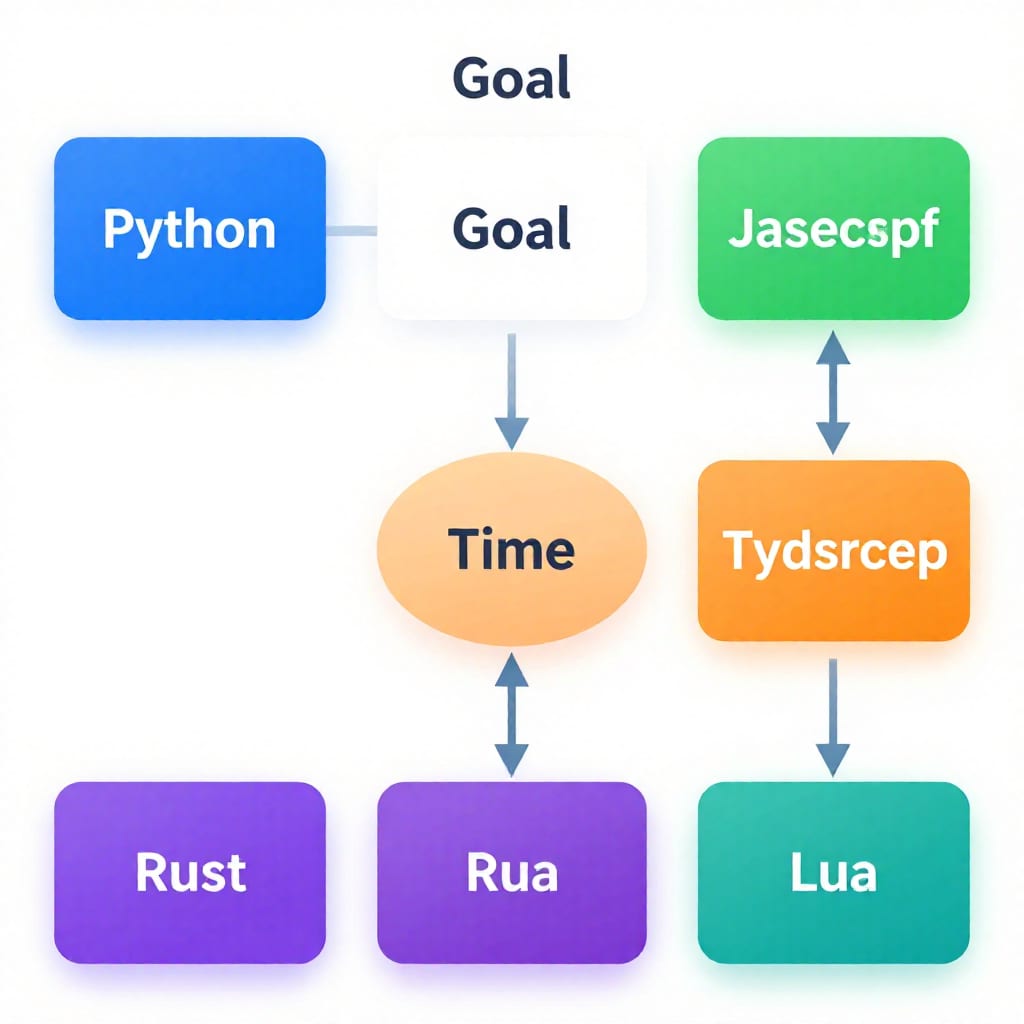
Here's the flowchart logic: If you answered "web" to Q1, go JavaScript or TypeScript. If "data" or "automation," go Python. If "games" and you want quick wins, start Lua. If you're ambitious and have time, try Rust—but plan for a longer ramp. The key is to commit for 30 days before switching. That's the minimum to know if a language clicks.
The Truth About 'Easy' Languages and Long-Term Value
I've seen beginners chase "easy" languages like Scratch or drag-and-drop tools, only to hit a wall when they need real coding skills. Here's the honest truth: every language has a learning curve, and the first one is always the hardest. What matters is not how easy the syntax is on day one, but how well the language teaches you transferable concepts—loops, conditionals, debugging, and problem decomposition.
Python gets called easy, but it still demands logical thinking. Rust is hard, but it forces you to think about memory in a way that applies to C++, C, and even Java. My counter-intuitive advice? Don't optimize for ease; optimize for momentum. Pick a language that lets you build a real project within two weeks. That project—not the syntax—is what keeps you learning. I've mentored a musician who learned Python to automate her MIDI setup, and a gamer who learned Lua to mod his favorite game. Neither cared about "easy"; they cared about making something they loved.
Frequently Asked Questions
Can I start with a 'hard' language like Rust or C++ as a total beginner?
Yes, but expect a steeper learning curve. Rust is doable if you have patience and a strong goal (e.g., systems programming). Most learners find Python or JavaScript easier to build momentum with. I'd only recommend starting with Rust if you have a mentor or a lot of free time.
Do I need to be good at math to learn programming?
Not for most beginner web or app development. Logic and problem-solving matter more than advanced math. Data science or game physics may require some math later, but you can cross that bridge when you come to it.
Should I use AI coding assistants (like GitHub Copilot) as a beginner?
They can help with boilerplate and debugging, but rely too much and you'll miss learning core concepts. Use them as a tutor, not a crutch. I suggest writing the first 20–30 programs entirely by hand before turning AI on.
How long does it take to land a job after learning a first language?
Varies widely: 6 months to 2 years depending on daily practice, projects, and job market. Focus on building a portfolio, not just finishing courses. The first job is the hardest; be prepared to apply to dozens of roles.
Should I learn two languages at once as a beginner?
No. Stick with one until you're comfortable with basic concepts (variables, loops, functions). Then branching out is easier and actually reinforces learning. I made the mistake of juggling Python and JavaScript early on—I ended up confusing syntax for weeks.
Practical Takeaway
Choosing a first language in 2025 is less about picking the "best" one and more about picking the one that will keep you coding for the next 30 days. Python remains the safest bet for most beginners, but if you're drawn to web development, JavaScript or TypeScript is a strong choice. Rust is for the ambitious, and Lua is for the curious. Whatever you choose, remember: the language is just a tool. The real skill is learning how to learn. Start building something small this week, and the rest will follow.